When you design or maintain hydraulic equipment, you quickly realize how much performance depends on effective sealing. And that’s especially true for hydraulic cylinder seals, which are the frontline components keeping hydraulic oil exactly where you need it. If sealing fails, efficiency drops, contamination increases, and the machine can’t deliver the power you expect.
In this guide, I’ll walk you through nine typical hydraulic oil sealing methods—the same methods you’ll evaluate when you’re specifying components, diagnosing leakage, or improving system reliability. I’ll speak to you directly, the way I would if we were reviewing a cylinder design together or troubleshooting a leak on-site. My goal is to help you understand not only what choices you have, but how each method works and what details you must control to ensure your system stays tight.
1. Radial Shaft Sealing (Rotary Sealing)
When you deal with rotating shafts — pump drives, motor shafts, rotary actuators—radial shaft seals become central to your sealing strategy. You’ve likely used these seals to manage lubrication on one side and contamination on the other.
What you should focus on
-
Shaft finish: If your shaft is too rough or too smooth, the seal lip won’t form a stable oil film. You generally want a Ra of 0.2–0.8 µm for elastomeric lips.
-
Shaft hardness: If you run in abrasive environments, aim for harder surfaces (40–60 HRC) to slow down wear.
-
Seal material: NBR is common for mineral oil; FKM handles higher temperatures; PTFE helps when friction and heat become problems.
-
Lip geometry: Hydrodynamic and multi-lip designs help you when shaft speed or contamination risk increases.
What to look for if problems start
If you see lip abrasion, cracked edges, or a dark glazed appearance on the seal, you may have alignment problems, poor finish, or contamination.
A practical tip for you
When the DN value (diameter × rpm) gets high, switching to PTFE-based rotary seals will reduce heat and prolong seal life.
2. Axial Face Sealing (Static Flat Interfaces)
Whenever you close a cover plate, bolt down a manifold, or join housing sections, you rely on face sealing. These joints don’t move, but they must hold pressure reliably.
What you should control
-
Material choice: PTFE gaskets, graphite composites, or elastomer-coated metal gaskets — the right choice depends on your temperature and chemical environment.
-
Bolt load and pattern: Uneven torque is a major cause of leaks. Use calibrated tools and cross-pattern tightening.
-
Surface flatness: A slight waviness in the metal can create micro-paths for oil seepage.
-
Compression set characteristics: Some materials hold long-term compression better; selecting them saves you future maintenance.
If something leaks
You’ll usually notice seepage along bolt lines. This tells you your compression wasn’t uniform or that thermal changes relaxed the gasket.
Friendly advice
Make sure your drawing states the exact compression target, especially if you’re working with PTFE. It removes guesswork during assembly.
3. O-Ring Groove Sealing — Simple but Highly Sensitive to Geometry
O-rings may look simple, but you already know performance depends heavily on groove design.
What you must ensure
-
Correct squeeze: For static seals, you want about 20–30% squeeze; for dynamic sealing, keep it lower to cut friction and heat.
-
Extrusion gap: If pressure is high, you need backup rings. Even a 0.1 mm excess clearance can lead to extrusion failures.
-
Surface quality: Avoid scratches and machining marks in the gland area.
-
Material compatibility: NBR for mineral oils, HNBR for stronger mechanical properties, and FKM for high temperatures. Avoid EPDM with standard hydraulic oils.
When the O-ring fails
Cuts, nicks, and flat sections typically point to assembly issues, sharp groove edges, or thermal overstress.
A practical note
If you standardize groove dimensions based on ISO 3601 and include them in your drawings, you’ll prevent a lot of unnecessary troubleshooting in the future.
4. Lip-Type Rod and Piston Seals—Your Main Dynamic Oil Retention System
Whenever you work with reciprocating motion, rod seals and piston seals become your primary barrier against leakage.
Key details you should pay attention to
-
Seal profile: U-cups, double-acting seals, or pressure-energized profiles—each behaves differently under acceleration and pressure spikes.
-
Guide rings: Without proper guidance, your rod or piston drags the seal sideways, accelerating wear.
-
Preload: Some seals depend on a built-in energizer to maintain contact even at low pressure.
-
Surface finish: Rod and bore finishes directly influence friction and oil film stability.
Common symptoms
If you see streak marks or polished bands on the rod, it often means contamination or a worn wiper. Lip rollover means the groove depth or rod alignment needs correction.
Friendly reminder
Never ignore the wiper. A good wiper seal protects your rod seal from external contamination—one of the biggest threats to seal life.
5. PTFE Wear-Compensation Seals—Your Solution for Low-Friction and High-Cycle Applications
PTFE seals are excellent when you’re dealing with fast strokes, high duty cycles, or high temperatures.
What you should consider
-
Filler type: Bronze-filled PTFE gives you durability; glass-filled PTFE provides stiffness; carbon-filled blends work well when heat management matters.
-
Energizer choice: Like spring energised PTFE seals, elastomer energizers are flexible; metal springs ensure long-term stability under heat.
-
Bore and rod surface hardness: PTFE can polish softer metals, so ensure the hardness meets the requirements.
Common failure signs
Creep deformation or flattened sealing areas indicate excessive temperature or unsupported geometry.
Useful tip
If you’re trying to reduce stick-slip, PTFE is often your most dependable option.
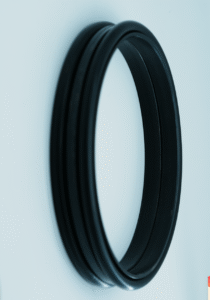
6. Mechanical Face Seals(Floating/Seal Face) — Ideal for Harsh, Abrasive Environments
Application space.
You see floating seals in heavy equipment where mud, sand, or abrasive media threaten conventional lip seals — final drives, heavy cylinder end caps, track rollers.
Key implementation points.
-
Face material and finish: Hard ceramic or carbide faces with a lapped finish (Ra <0.05 µm) reduce wear.
-
Preload and axial float: Controlled preload ensures a constant contact force while allowing axial movement for misalignment.
-
Secondary elastomeric elements: Toric seals or O-rings behind the faces isolate internal oil from the external environment.
Failure diagnostics.
-
Scoring or glazing of faces indicates abrasive ingress.
-
Loss of face flatness: overheating or shock load.
Practical tip for you
If your equipment runs in heavily contaminated sites, prefer mechanical face seals with accessible maintenance intervals and ensure a robust dirt-exclusion path is part of the mechanical design.
7. Threaded and Port Sealing — Small Components, Big Consequences
Threaded joints cause far more hydraulic leaks than most engineers expect. If you’ve ever chased a slow, intermittent leak, you know how tricky these connections can be.
What you should standardize
-
Bonded seals (Dowty) for flange faces and SAE ports.
-
ORB/ORFS fittings for easy service and reliable sealing.
-
Avoiding overtightening: Excess torque distorts sealing faces.
Common leak causes
Thread sealant overuse, damaged port faces, reused bonded seals, or non-calibrated torque tools are typical culprits.
Practical reminder
Always replace bonded washers during critical reassembly. They’re inexpensive and save you hours of troubleshooting later.
8. Seal Stacking and Redundant Systems—For Pressure Spikes and Safety
In high-pressure or high-shock applications, stacking seals gives you extra protection—but only if you manage inter-seal pressure correctly.
What you must plan
-
Pressure relief between seals: Without it, trapped oil will overload your secondary seal.
-
Material pairing: Using two identical seals isn’t always ideal—friction and wear behavior differ.
-
Thermal expansion control: Stack height changes under heat and can increase preload.
Warning signs
If your second seal fails faster than the first, pressure entrapment is usually the root cause.
A helpful tip
Design a venting or lubrication path between stacked seals whenever you expect pressure fluctuations.
9. Metal-to-Metal Sealing — Precision Engineering for Extreme Conditions
You turn to metal-to-metal sealing when pressures or temperatures exceed what polymers can handle.
What matters most
-
Geometry: Conical or spherical seats distribute load evenly.
-
Material hardness: Mismatched hardness leads to scoring.
-
Surface finish: Extremely fine finishing prevents micro-leaks.
Symptoms to watch
High-temperature cycling often causes micro-leaks if the mating materials expand at different rates.
Friendly advice
Use metal-to-metal sealing only when needed. It is precise, reliable, but machining and quality control requirements are strict.
How You Choose the Right Sealing Method
When you’re designing or upgrading a hydraulic system, evaluate sealing methods through these lenses:
-
Type of motion: rotary, reciprocating, or static.
-
Operating pressure: continuous vs peak.
-
Temperature conditions: normal or elevated.
-
Fluid type: mineral oils vs synthetic ester fluids.
-
Environmental exposure: dust, mud, or water.
-
Service accessibility.
-
Lifecycle expectations: durability vs cost.
If you follow these steps, you can quickly narrow down which seal kits fit your application. The more clearly you define your operating envelope, the more predictable your sealing performance becomes.
Installation, Maintenance, and Troubleshooting — What You Should Do in Practice
When installing
-
Deburr all edges.
-
Check surface finishes and groove dimensions.
-
Use compatible assembly lubricants.
-
Install seals using appropriate tools to avoid stretching or nicking.
During maintenance
-
Inspect rods and bores for wear tracks.
-
Check wipers for contamination build-up.
-
Perform oil cleanliness testing — contaminants destroy seals faster than pressure does.
When troubleshooting
-
Slow seepage → wiper or lip degradation.
-
Sudden failure → extrusion or incorrect installation.
-
Intermittent leaks → thermal cycling or incorrect torque on joints.
Final Thoughts for You — Engineering Sealing with Confidence
If you treat sealing as a systems engineering process — not just a component choice — you’ll achieve far more stable performance.
Here’s what I want you to take away:
-
Define your operating conditions precisely.
-
Match seal geometry and materials to your real system behavior.
-
Document every tolerance and torque value.
-
Control contamination aggressively.
-
Test your assembly before full operation.
When you approach sealing with this mindset, you reduce downtime, extend component life, and create hydraulic systems that stay tight under real-world demands.
✅ A Practical Recommendation for Your Real-World Needs
After you understand these nine hydraulic oil sealing methods, you may still face a common challenge: finding a manufacturer that actually understands your application and delivers seals that match your cylinder’s working conditions, not just the catalog description.
If you ever need support, my team at TYS can assist you in a straightforward and down-to-earth manner.
We don’t try to oversell anything to you. You just tell us your request and your budget
We will match the seals that make sense for you — whether it’s PTFE, HNBR, NBR, PU, or a fully customized sealing solution.
If you need samples, technical drawings, or material recommendations, we can walk you through everything step by step, just like talking to an old friend who has dealt with hydraulic cylinder seals for years.
So whenever you’re stuck choosing the correct sealing structure or you’re unsure which material gives you more stability for your hydraulic oil, you’re always welcome to ask.
TYS focuses on hydraulic and PTFE sealing parts year by year, and we’re happy to share our experience to help you avoid sealing failures and unnecessary costs.