Floating seal installation is actually simple and more straightforward than you think, but you need to follow the installation steps carefully. When you get the floating oil seal, you do not install it directly, but we need to make some preparations before installation. When working, avoid damaging the seal during the installation process, and make sure that no particles of dust or impurities are adhered to during installation.

The specific installation method is as follows:
Check the working environment and the floating oil seal
Before installing the floating oil seal, you should make preparations, check whether the working environment is clean, prepare the new floating oil seal and installation tools to be replaced, and check whether the new floating oil seal is damaged, cracked, or oily and corroded. If there are any of these adverse phenomena, the oil seal should be replaced with a new one.
Check the journal
You need to check whether there are any scars on the journal, especially whether there are long scars along the axial direction, and whether the surface is rough. If the surface of your journal has severe blunt impact scars due to improper disassembly and assembly, the oil seal lip and the journal surface will not fit tightly, causing oil leakage. If your journal surface is too rough, it will easily damage the oil seal or accelerate the wear of the seal lip, destroying its sealing performance. You can overlay the scarred part and then return it on a lathe according to the specified journal size, or you can replace the new shaft. If the journal only has metal burrs or flash edges on the shaft head, you can use a file to smooth it out. Prevent damage to the oil seal lip when installing the oil seal.
Clean and lubricate the floating oil seal and journal
During the installation process of the floating oil seal, the oil seal (especially the lip area) and the journal area should be kept clean, and care should be taken not to cause the oil seal self-tightening spring to jump out of the spring groove. If the self-tightening spring is relaxed and the elastic force is weakened, you can cut it into a section and connect the two ends firmly before continuing to use it. You can apply lubricant to the journal after cleaning to make installation easier.
Use tools to assist installation
When installing the floating oil seal and the skeleton oil seal, special installation tools must be used to prevent the oil seal lip from being stretched, deformed, or scratched. If you don’t have this tool, you can install it as follows:
a. First step, roll a layer of transparent hard plastic film (commonly known as cellophane) on the journal and even the shaft head, apply a little engine oil on its surface, insert the oil seal into the shaft head wrapped with the plastic film, and push the oil seal evenly Slowly push to the journal, and then pull out the plastic film. (Note: Do not install the lip in the wrong direction. It should face the inside, where the oil is stored, and the side with the trademark and specifications should face the outside. Because the lip can only seal in one direction, if the oil seal is reversed, oil leakage will inevitably occur. Leakage, sealing effect weakened or failed.
b. In the second step, align the shaft and bearing seat. Improper alignment may cause early wear or leakage of the oil seal. Avoid cooking the oil seal or hitting the surface of the oil seal with hammers or other tools. Otherwise, the oil seal may be easily damaged.
Check the installation
Check whether the floating oil seal is installed correctly and the installation quality is correct. Make sure it is installed in its fixed position, and check whether the shaft can rotate freely without being affected by the oil seal.
Test use
Finally, before putting the equipment into formal use, perform a test operation to test whether there will be oil leakage or regular rotation.
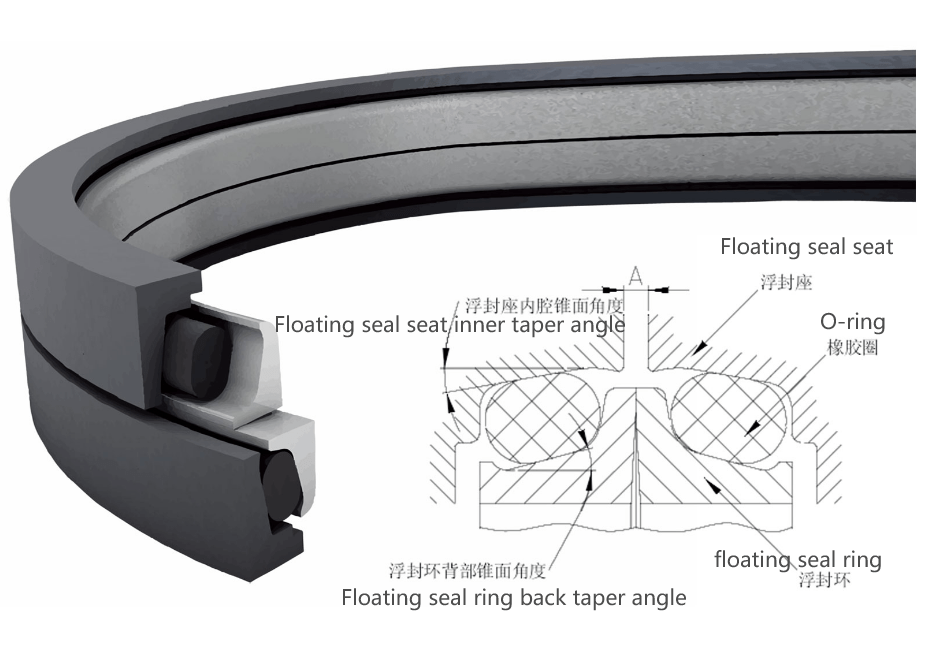
Installation tips (you wish someone had told you earlier)
Floating seals often fail not because of design flaws but because of installation mistakes. If you’ve ever seen uneven wear, dry running, or one side turning blue, it’s usually a handling problem.
Here’s what you want to pay extra attention to:
1. Keep everything clean
Dust on sealing faces is like sand in your sandwich—you simply don’t want it.
2. Lubricate the elastomer ring properly
Use compatible grease. Not too much, not too little. Excess grease can cause the ring to roll or twist.
3. Ensure correct compression
Each seal type has a recommended axial compression. Too tight, and wear accelerates; too loose, and leakage appears.
4. Seat the metal rings evenly
You want both sides to sit flat. If one side is slightly angled, the mating faces won’t meet correctly.
5. Avoid hitting the rings
They may look heavy, but their lapped faces are precision surfaces. Dropping them is never a great idea.
Please note that the above are the correct installation methods and precautions for floating oil seals. The above steps are for reference only. Different models of equipment may have slight differences and unique requirements. It is best to consult the relevant manual instructions or consult professional technical personnel for guidance before installation. , I hope you can correctly install the floating oil seal during daily maintenance to ensure the regular operation of mechanical equipment.