A hydraulic cylinder seal kit keeps your hydraulic system efficient, leak-free, and safe—the invisible force behind reliable equipment performance.
Understanding The Core Function Of A Hydraulic Cylinder Seal Kit
If you work with hydraulic machinery, you already know one truth:
A cylinder is only as reliable as its sealing system.
A hydraulic cylinder seal kit is a collection of precision-engineered sealing components designed to maintain pressure, prevent fluid leakage, and keep contaminants out.
In other words, it’s not just a “rubber set”—it’s the core barrier between performance and failure.
Each seal inside the kit serves a specific mechanical and chemical function under dynamic load, extreme temperature, and fluctuating pressure.
When combined, they create a tight hydraulic system that ensures consistent force transmission.
How Hydraulic Cylinder Seal Kits Work
Inside a hydraulic cylinder, the fluid exerts pressure to move a piston.
As the piston moves, seals create a tight separation between pressure zones, allowing controlled movement and precise force transfer.
The working process can be summarized as follows:
-
Piston seal maintains the differential pressure between the two chambers.
-
Rod seal prevents oil leakage toward the atmosphere.
-
Wiper seal cleans the rod as it retracts, keeping the interior clean.
-
Guide ring ensures concentric alignment and prevents side load.
-
Back-up ring supports softer seals under high pressure, avoiding extrusion.
A single damaged seal can cause the entire hydraulic system to lose efficiency or even fail catastrophically.
Engineering Science Behind Seal Materials
A high-performance seal kit depends on material science.
Every compound is formulated for a specific pressure, temperature, and chemical resistance.
| Material | Temperature Range | Key Advantages | Common Use |
|---|---|---|---|
| NBR (Nitrile Rubber) | -40°C to +120°C | Excellent oil resistance, cost-effective | Hydraulic oil, fuel systems |
| PU (Polyurethane) | -35°C to +110°C | High wear resistance, strong elasticity | Heavy-duty cylinders |
| PTFE (Teflon) | -60°C to +200°C | Low friction, chemical inertness | High-speed & special fluids |
| FKM (Viton) | -20°C to +200°C | Superior heat and chemical resistance | Chemical and engine seals |
| HNBR (Hydrogenated NBR) | -40°C to +150°C | Better ozone and temperature stability | Automotive and mining |
| POM (Polyoxymethylene) | -40°C to +120°C | Excellent dimensional stability | Guide rings and bushings |
A good engineer always evaluates media compatibility (oil, water-glycol, ester, and phosphate esters) before material selection.
A mismatch can lead to swelling, softening, or hardening—common causes of premature seal failure.
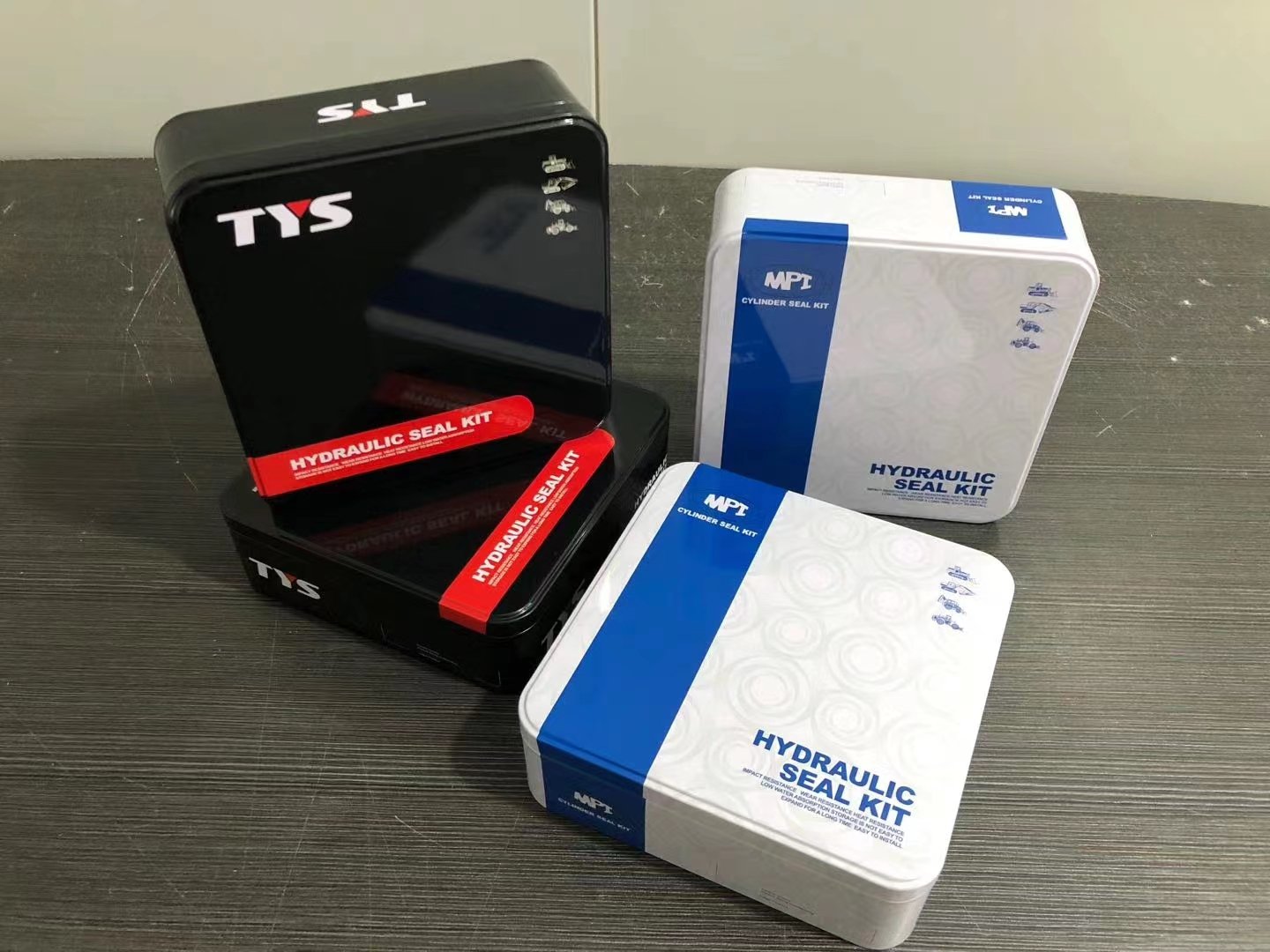
Types Of Hydraulic Cylinder Seal Kits
Not all seal kits are the same.
They vary depending on cylinder design, working conditions, and manufacturer requirements.
The most common types include:
-
Rod Seal Kits – Replace seals at the rod side (primary leakage zone).
-
Piston Seal Kits – Maintain chamber separation under dynamic load.
-
Complete Cylinder Repair Kits—Include all seals for full overhaul.
-
OEM Replacement Kits – Match original manufacturer specifications (Caterpillar, Komatsu, Parker, Bosch Rexroth).
-
Custom Kits—Designed for specific equipment, non-standard dimensions, or harsh environments.
TYS Seals specializes in custom-engineered seal kits for global OEM and aftermarket applications.
Selection Criteria—How To Choose The Right Kit
When choosing a hydraulic cylinder seal kit, focus on five key engineering factors:
-
System Pressure—Identify the working and peak pressures.
-
Temperature Range – Account for ambient and fluid heat.
-
Fluid Compatibility—Check whether the system uses mineral oil, synthetic, or water-based fluid.
-
Motion Speed—Dynamic vs. static load affects seal wear and extrusion risk.
-
Environmental Exposure—Dust, water, ozone, UV, and chemicals.
A professional supplier like TYS Seals offers material testing, tolerance analysis, and dimensional customization to ensure a perfect fit and reliability.
Common Failure Modes And Preventive Actions
Even the best seals fail if improperly selected or installed.
Understanding typical failure patterns helps prevent downtime. More information about the Seal Installation Guide.
| Failure Symptom | Probable Cause | Recommended Solution |
|---|---|---|
| Hardening or cracking | High temperature or ozone exposure | Switch to HNBR or FKM material |
| Swelling or softening | Incompatible media (ester, ketone) | Use EPDM or PTFE materials |
| Leakage or loss of elasticity | Compression set | Increase hardness (70–90 ShA) |
| Cold leakage | Low-temperature embrittlement | Use low-ACN or low-temp NBR |
| Extrusion or nibbling | High pressure or clearance gap | Add a backup ring or use a PTFE seal |
Best practices:
-
Keep installation surfaces clean.
-
Use hydraulic-compatible lubricants.
-
Avoid twisting during assembly.
-
Follow correct groove dimensions.
-
Replace full kits instead of single seals.
Advanced Seal Kit Design Considerations
For heavy-duty or special applications, standard seal kits may not perform adequately.
Engineers often modify designs to meet higher performance standards.
Key considerations include:
-
Pressure balancing between the piston and rod seals to avoid stick-slip.
-
Dual-lip seals for improved redundancy.
-
Composite materials (PTFE + elastomer energizers) for precision control.
-
Low-friction PTFE seals to reduce wear in fast-moving systems.
-
Dust-resistant wipers for outdoor or mining equipment.
-
Chemical-resistant FKM seals for hydraulic systems in oil & gas applications.
TYS engineers use finite element analysis (FEA) and dynamic test rigs to validate seal performance under simulated working conditions.
The Cost Impact Of Poor Sealing
Leaks are not just messy—they are financially expensive.
A minor hydraulic leak can cause:
-
Loss of hydraulic pressure and performance.
-
Contamination that damages pumps and valves.
-
Frequent maintenance downtime.
-
Safety hazards due to oil spray or fire risk.
Investing in a high-quality seal kit saves you long-term costs by reducing unplanned shutdowns and improving energy efficiency.
Benefits Of Premium Hydraulic Seal Kits
A professional-grade seal kit, such as those from TYS Seals, offers measurable advantages:
-
Consistent performance under extreme conditions.
-
Excellent compression set and low friction.
-
Longer service intervals and lower lifecycle cost.
-
Improved energy efficiency and fluid retention.
-
Tailor-made options for OEM and aftermarket users.
Every TYS kit is manufactured under ISO 9001:2015-certified processes, with rigorous dimensional inspection, surface testing, and 100% visual verification before shipment.
Conclusion
A hydraulic cylinder seal kit is more than spare parts—it’s precision-engineered protection for your system’s power, safety, and efficiency.