In hydraulic system maintenance, we often fall into a cognitive trap: believing that as long as we use the absolute best components, the problem will inevitably be solved. Especially when facing the notorious “headache” of cylinder leakage, many technicians’ first instinct is, “Domestic seals aren’t cutting it; let’s switch to imported ones this time!” However, reality often delivers a harsh reality check. After spending a premium on top-tier imported seals, the system starts up only for the oil to leak exactly as before. Why does this happen? Have imported seals been overly “mythologized”? Today, we will dive deep into the “hidden killers” that cause cylinder leakage, completely aside from the quality of the seals themselves.
01. Incorrect Seal Selection
“Expensive” does not mean “correct.” Imported seals come in a vast array of types and materials (such as polyurethane, PTFE, NBR, etc.), each engineered for specific working conditions.
- Operating Condition Mismatch: If your cylinder operates under long-term high-temperature, high-pressure, or high-speed environments, but you select a standard seal that cannot withstand high temperatures, it will rapidly age, deform, and lose elasticity—regardless of its premium imported status.
- Structural Selection Error: For instance, in piston sealing, should you use a Glyd Ring or a U-cup? These two have completely different applicable pressures and breakout friction torques. If the incorrect structure is selected, the seal cannot effectively “energize” and expand under high pressure, allowing oil to escape through the resulting gaps.
Solution: Before selection, you must confirm the system pressure, temperature, cylinder speed, and hydraulic oil type. Suitability is far more important than a hefty price tag.
02. Seal Damage During Installation
This is the most common and unfortunate scenario. Imported seals are typically characterized by higher material hardness and precise dimensional tolerances, requiring exceptional skill during assembly.
- Sharp Edge Scratches: If the cylinder barrel threads or oil port chamfers are not smooth, or if a guiding sleeve tool is omitted, forcing the seal over sharp edges will instantly cut a “wound” into its surface. This scratch acts as a direct channel for oil leakage.
- Twisting and Overturning: Uneven force applied when inserting the piston rod or piston can cause the seal ring to twist. Once twisted, the sealing lip cannot evenly conform to the metal surface, making leakage inevitable.
- Tool Damage: Using standard screwdrivers or sharp objects to pry the seal into place can easily puncture it directly.
Solution: Strictly adhere to the installation procedures recommended by imported brands. Clean all components, and always use specialized installation tools—protecting the seal is the top priority during assembly.
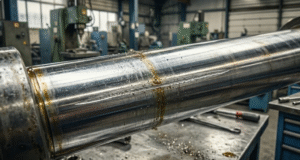
03. “Hidden Perils” on the Cylinder Inner Wall
Seals work by flush-fitting against the hydraulic cylinder inner wall or the piston rod. If the mating contact surface is compromised, no seal can save the system.
- Substandard Surface Roughness: Imported seals demand extremely high standards for metal surface roughness (typically Ra 0.1–0.4 μm). If the cylinder’s inner wall is scored, corroded, or has machining marks that are too deep, the seal will act as if it is rubbing against sandpaper, quickly wearing down and leaking.
- Geometric Precision Out of Tolerance: The cylinder barrel may develop “taper” or “ovalization.” The matching clearance for imported seals is usually tight; once the cylinder deforms, the clearance fluctuates, and the seal will be “extruded” into the gap and sheared apart.
Solution: Before replacing seals, thoroughly inspect the cylinder inner wall and piston rod surface. Bore the cylinder or replate chrome when necessary. A good horse deserves a good saddle.
04. “Invisible Wear” on the Piston Rod Surface
Scratches, rust spots, or minor flaking of the chrome plating on the piston rod act as “chronic killers” for seals. Frequently, the piston rod looks bright and shiny to the naked eye, but running a finger along it reveals subtle longitudinal scoring. When the seal lip passes over these imperfections during high-speed reciprocating motions, it suffers an impact every single time, leading to rapid fatigue failure of the seal lip.
Solution: Inspect the piston rod surface using your fingernail or fine sandpaper. If scoring is detected, the piston rod must be repaired or replaced.
05. Overlooking the “Extrusion Gap.”
This is a technical detail easily overlooked by even experienced technicians. Under high pressure, the seal is pushed toward the clearance gap. If the guide ring (wear ring) is worn out or missing entirely, the high pressure will squeeze the heel of the seal into the clearance between the piston and the cylinder barrel, causing the root to be nibbled away. While imported seals offer high-pressure resistance, if you are working on older equipment where the worn clearance already exceeds specifications, even the finest seal cannot escape being destroyed by extrusion.
Solution: Measure the mating clearance between the piston and cylinder barrel, as well as between the piston rod and guide sleeve. If tolerances are exceeded, thicken the guide ring or replace the mechanical components.
Conclusion
While imported seals certainly offer superior performance advantages, they are not a magical “one-size-fits-all patch.” In fact, 70% of cylinder leakage causes lie not within the seal itself but in the “people” and the “environment.”
- People: Is the installation standardized? Is the selection logical?
- Environment: Is the cylinder barrel worn? Is the piston rod smooth?
The next time you encounter a leaking hydraulic cylinder, don’t rush to complain that “even imported parts don’t work.” First, ask yourself: Have you provided that seal with a perfect “home”? Hydraulic seal selection is a rigorous mechanical art where details dictate success or failure.
Need professional advice on selecting the right hydraulic seals for your equipment? Contact TYS Seals today to get expert support and premium sealing solutions!
If leakage returns on the same side of the rod, inspect the chrome surface carefully. A pitted hydraulic cylinder rod can damage a replacement seal quickly, so the rod may need polishing, replating, or replacement before another seal kit is installed.