Engineering Guide
Hydrogen sealing performance depends on the complete system: compound selection, RGD resistance, pressure, temperature, extrusion control, seal profile and surface finish.
Quick Summary
Hydrogen sealing is not simply a matter of choosing an O-ring that can withstand pressure.
Hydrogen molecules are extremely small, high-pressure systems may operate at 35 MPa, 70 MPa or higher, and repeated pressurization and decompression can cause gas to diffuse into sealing materials and damage them internally.
For engineers and equipment manufacturers, a reliable hydrogen seal must control several risks at the same time:
- Hydrogen permeation
- Rapid gas decompression (RGD)
- Seal extrusion under high pressure
- Low-temperature hardening
- Compression set
- Friction and wear
- Pressure cycling
- Groove and extrusion-gap design
This is why hydrogen seals should be selected as a complete material + seal profile + groove + operating condition system rather than by material name alone.
Why Is Hydrogen So Difficult to Seal?
Hydrogen creates sealing problems that are less severe in many conventional hydraulic and pneumatic systems. The challenge comes from a combination of molecular size, pressure, temperature and repeated operating cycles.
Hydrogen Permeation
Hydrogen can diffuse into elastomers and some polymer materials. Permeation itself does not always mean immediate seal failure. However, it increases the risk of gas migration through the seal and can contribute to internal damage during rapid decompression.
The actual permeation rate depends on:
- Polymer structure
- Compound formulation
- Seal thickness
- Temperature
- Pressure differential
- Exposure time
This is why comparing materials only by hardness or temperature rating is insufficient.
A seal may appear mechanically strong but still allow unacceptable hydrogen permeation.

What Is Rapid Gas Decompression in Hydrogen Seals?
Rapid gas decompression, often abbreviated as RGD, is one of the most important failure mechanisms in high-pressure hydrogen sealing.
Under pressure, hydrogen can diffuse into an elastomer seal.
If system pressure drops slowly, the gas may leave the material gradually. If pressure drops rapidly, however, the hydrogen trapped inside the material may expand faster than it can escape.
This can create internal stresses and lead to:
- Blistering
- Internal cracking
- Splitting
- Surface damage
- Permanent loss of sealing force
- Complete seal rupture
RGD resistance therefore becomes especially important in:
- Hydrogen compressors
- High-pressure valves
- Pressure regulators
- Hydrogen storage systems
- Refueling equipment
- Connectors
- High-pressure fittings
Hydrogen RGD Is a Compound-Level Issue
Compound-level warning: A common mistake is to say that EPDM is suitable for hydrogen or that FKM is not suitable for hydrogen.
That is too simplistic.
Two compounds from the same polymer family can behave very differently.
Performance can change depending on:
- Polymer grade
- Crosslinking system
- Fillers
- Plasticizers
- Reinforcement
- Hardness
- Compound density
- Manufacturing process
Therefore, hydrogen compatibility should be evaluated at the specific compound level, not only at the generic material-family level.
For critical hydrogen applications, engineers should ask for evidence of hydrogen compatibility, permeation performance or RGD testing whenever required by the project.
How to Select Seal Materials for Hydrogen Applications
EPDM Hydrogen Seals
EPDM is widely considered for hydrogen applications because specially formulated EPDM compounds can provide:
- Good low-temperature flexibility
- Good compression-set performance
- Good resistance to many water-based environments
- Good performance in static sealing applications
Hydrogen-specific EPDM compounds are available for high-pressure service and can be formulated for low permeability and RGD resistance.
Typical applications may include:
- Hydrogen valves
- Filters
- Connectors
- Electrolyzers
- Fuel-cell components
- Refueling equipment
However, standard industrial EPDM should not automatically be assumed to be suitable for high-pressure hydrogen.
The compound must be matched to the pressure, temperature and decompression conditions.
FKM Hydrogen Seals
FKM is often selected when higher operating temperatures and chemical resistance are important.
Potential advantages include:
- High-temperature capability
- Good chemical resistance
- Good compression-set resistance
- Stable sealing performance in demanding environments
However, FKM compounds vary significantly in low-temperature flexibility and hydrogen permeation behavior.
For this reason, FKM is usually selected when the operating temperature and chemical environment justify it, rather than simply because it is considered a premium elastomer.
HNBR Hydrogen Seals
HNBR combines good mechanical strength with improved temperature and chemical resistance compared with conventional NBR.
Depending on formulation, HNBR may provide:
- High tensile strength
- Good extrusion resistance
- Good wear resistance
- Good pressure capability
- RGD-resistant formulations
HNBR can therefore be considered for demanding high-pressure gas applications.
Hydrogen service should still be based on verified compound performance rather than assuming all HNBR grades will behave the same way.
PTFE Hydrogen Seals
PTFE is particularly valuable in hydrogen sealing because of its:
- Very low friction
- Wide temperature capability
- Excellent chemical resistance
- Low moisture absorption
- Good dimensional stability
- Suitability for both static and dynamic seal designs
PTFE is frequently used in:
- Spring-energized seals
- Composite sealing systems
- Dynamic valve seals
- Compressor sealing components
- Backup rings
- Low-friction reciprocating seals
Filled PTFE compounds can improve:
- Wear resistance
- Creep resistance
- Extrusion resistance
- Mechanical strength
TPU and Polyurethane Hydrogen Seals
Polyurethane offers high mechanical strength and excellent resistance to wear and extrusion.
Hydrogen-specific thermoplastic polyurethane compounds are increasingly being developed for demanding applications, including low-temperature and high-pressure environments.
Potential advantages include:
- High extrusion resistance
- High wear resistance
- Good mechanical strength
- Suitability for dynamic sealing
However, conventional hydraulic polyurethane should not automatically be used in hydrogen systems.
The specific formulation must be evaluated for hydrogen compatibility, permeation, RGD, temperature and pressure cycling.
PEEK Backup Rings
PEEK is particularly useful as a structural and anti-extrusion material.
Its advantages include:
- High mechanical strength
- High-temperature capability
- Excellent dimensional stability
- Strong extrusion resistance
- Good chemical resistance
PEEK is therefore commonly considered for backup elements in very high-pressure sealing assemblies.
Hydrogen Seal Material Comparison
| Material | Main Strength | Main Concern | Typical Hydrogen Use |
|---|---|---|---|
| EPDM | Low-temperature flexibility, static sealing | Compound-dependent permeation and RGD | Valves, electrolyzers, fuel-cell systems |
| FKM | Heat and chemical resistance | Low-temperature performance and compound-dependent permeability | High-temperature hydrogen equipment |
| HNBR | Mechanical strength and extrusion resistance | Compound validation required | High-pressure gas systems |
| PTFE / Filled PTFE | Low friction, chemical resistance, wide temperature range | Creep and need for energization or support | Dynamic seals, spring-energized seals, backup rings |
| Hydrogen-specific TPU | Wear and extrusion resistance | Standard PU may not be hydrogen-qualified | Dynamic high-pressure sealing |
| PEEK | Mechanical support and anti-extrusion | Not normally the primary compliant sealing element | Backup rings and support elements |
Why Anti-Extrusion Design Matters in High-Pressure Hydrogen
At 35 MPa, 70 MPa or higher, seal material can be forced into the clearance between mating components.
This is known as extrusion.
Extrusion damage often appears as:
- Nibbled seal edges
- Cut sealing lips
- Torn O-rings
- Permanent deformation
- Progressive leakage
The risk increases when:
- Pressure rises
- Extrusion gap becomes larger
- Temperature increases
- Seal material becomes softer
- Pressure cycles repeatedly
Therefore, high-pressure hydrogen sealing often requires more than a single O-ring.
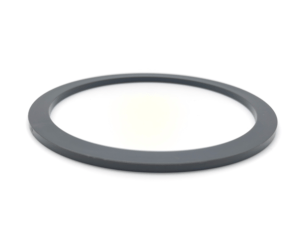
O-Ring + Backup Ring
A common solution is to combine an elastomer O-ring with one or two backup rings.
The O-ring provides sealing force.
The backup ring limits deformation into the extrusion gap.
Depending on pressure direction, the design may use:
- One backup ring for unidirectional pressure
- Two backup rings for bidirectional pressure
Typical backup materials include:
- PTFE
- Filled PTFE
- PEEK
- Other high-strength engineering polymers
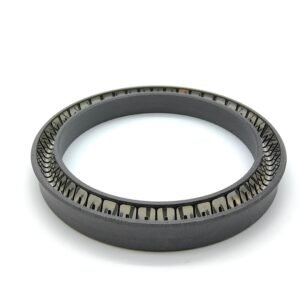
Spring-Energized PTFE Seals for Hydrogen
Spring-energized PTFE seals are useful when low friction, wide temperature capability and reliable preload are required.
The seal normally consists of:
- A PTFE or filled-PTFE jacket
- A metallic energizing spring
At low or zero pressure, the spring pushes the sealing lip against the mating surface.
As system pressure increases, pressure also energizes the seal and increases contact force.
This design can be suitable for:
- Hydrogen valves
- Regulators
- Compressors
- Reciprocating components
- Cryogenic or low-temperature equipment
- Applications requiring low friction
Static vs Dynamic Hydrogen Seals
Static Hydrogen Sealing
Examples include:
- Flanges
- Connectors
- Pressure vessel ports
- Valve bodies
- Electrolyzer frames
Main priorities are:
- Permeation control
- Compression set
- RGD resistance
- Extrusion resistance
- Long-term sealing force
Dynamic Hydrogen Sealing
Examples include:
- Compressor rods
- Valve stems
- Actuators
- Regulators
- Pump components
Dynamic applications add several additional requirements. For related groove, friction and material considerations, review our hydraulic valve seal technical guide:
- Friction
- Wear
- Heat generation
- Surface finish
- Lubrication
- Speed
- Pressure cycling
How Temperature Changes Hydrogen Seal Performance
Hydrogen systems may operate across very wide temperature ranges. For related material behavior and selection principles, see our guide to how temperature affects hydraulic seals.
High-pressure gaseous hydrogen equipment may experience low ambient temperatures and decompression cooling.
Liquid hydrogen operates at approximately -253°C, which requires specialized cryogenic sealing technology.
At low temperature, elastomers can:
- Become harder
- Lose flexibility
- Lose contact force
- Increase leakage risk
At high temperature, seals may experience:
- Increased permeation
- Faster aging
- Compression-set deterioration
- Reduced extrusion resistance
This is why the minimum and maximum temperatures must always be included in seal selection.
Surface Finish Also Matters
Material selection alone cannot solve hydrogen leakage.
Hydrogen sealing performance is also influenced by:
- Surface roughness
- Groove dimensions
- Extrusion gap
- Roundness
- Concentricity
- Surface damage
- Assembly condition
In dynamic applications, poor surface finish may accelerate wear.
In static applications, excessive roughness can create leakage paths.
Common Hydrogen Seal Failure Modes
1. Permeation Leakage
Cause: Hydrogen diffuses through or around the sealing material.
Engineering response:
- Select lower-permeability compounds
- Improve interface finish
- Optimize seal geometry
2. Rapid Gas Decompression Damage
Cause: Absorbed gas expands rapidly when pressure drops.
Symptoms:
- Blisters
- Cracks
- Internal splits
- Surface rupture
Engineering response:
- Use RGD-resistant compounds
- Control decompression rate where possible
- Select appropriate hardness and compound formulation
- Validate actual pressure cycling
3. Extrusion
Cause: High pressure forces the seal into the clearance gap.
Engineering response:
- Reduce extrusion gap
- Add backup rings
- Use higher-strength materials
- Optimize groove geometry
4. Low-Temperature Leakage
Cause: Elastomer becomes too hard to maintain sealing contact.
Engineering response:
- Select low-temperature compounds
- Evaluate glass-transition behavior
- Consider energized PTFE designs
- Verify pressure and temperature simultaneously
5. Excessive Wear
Cause: Friction, poor surface finish, high speed or unsuitable material.
Engineering response:
- Use lower-friction compounds
- Improve surface finish
- Optimize lubrication
- Review seal profile and preload
6. Compression Set
Cause: Elastomer loses its ability to recover after prolonged compression.
Engineering response:
- Select a suitable compound
- Optimize squeeze
- Avoid excessive temperature
- Review groove dimensions
Where Are Hydrogen Seals Used?
Hydrogen Production
Typical equipment includes:
- PEM electrolyzers
- Alkaline electrolyzers
- Hydrogen separators
- Valves
- Pumps
- Compressors
Hydrogen Compression
Compressors are among the most demanding hydrogen sealing applications.
Seals may experience:
- Reciprocating motion
- High pressure
- High temperature
- Limited lubrication
- Repeated pressure cycling
Hydrogen Storage
High-pressure hydrogen storage systems commonly operate around 35 MPa or 70 MPa.
Typical sealing points include:
- Valves
- Regulators
- Connectors
- Pressure-control systems
- Fittings
Hydrogen Refueling Equipment
Hydrogen refueling stations use seals in:
- Dispensers
- Nozzles
- Breakaway devices
- Valves
- Compressors
- Regulators
- Couplings
Fuel Cells
Important requirements may include:
- Gas separation
- Low leakage
- Chemical compatibility
- Temperature cycling
- Long service life
- Precision gasket geometry
How to Specify a Hydrogen Seal
Before requesting a hydrogen seal quotation, provide as much of the following information as possible.
1. Medium
- Pure hydrogen
- Hydrogen concentration
- Gas mixture
- Moisture level
- Other chemicals in contact with the seal
2. Pressure
- Normal working pressure
- Maximum pressure
- Pressure differential
- Pressure-cycle frequency
3. Decompression Condition
- Typical pressure drop
- Decompression speed
- Emergency depressurization conditions
4. Temperature
- Minimum temperature
- Normal working temperature
- Maximum temperature
- Thermal cycling conditions
5. Static or Dynamic Application
For dynamic seals, also provide:
- Reciprocating or rotary motion
- Speed
- Stroke
- Frequency
- Lubrication condition
6. Groove Dimensions
- Groove drawing
- Seal ID and OD
- Groove width
- Groove depth
- Extrusion gap
- Mating component dimensions
7. Surface Finish
For dynamic hydrogen sealing, specify mating-surface finish whenever possible.
8. Leakage Requirement
Different hydrogen equipment may have very different allowable leakage limits.
Define the project requirement before selecting the seal system.
9. Service-Life Requirement
Specify whether the seal is expected to operate for:
- A fixed number of pressure cycles
- A fixed number of operating hours
- A defined maintenance interval
Why a Standard Hydraulic Seal May Fail in Hydrogen
A standard hydraulic seal is normally designed around hydraulic oil, lubrication and liquid-pressure conditions.
Hydrogen introduces different failure mechanisms.
A seal that works reliably in hydraulic oil may fail in hydrogen because of:
- Higher gas permeation
- RGD
- Dry or poorly lubricated operation
- Rapid pressure cycling
- Extreme temperature
- Higher extrusion risk
Therefore, simply replacing the hydraulic medium with hydrogen without re-evaluating the seal material and design is not recommended.
TYS Custom Hydrogen Sealing Solutions
Hydrogen sealing projects often require more than a catalog-size seal.
TYS provides custom sealing solutions using materials and technologies including:
- PTFE
- Filled PTFE
- FKM
- NBR
- TPU
- PEEK
- POM
- Nylon
- Backup rings
- Custom-machined seals
- Spring-energized PTFE seals
For demanding applications, we evaluate the seal based on the complete operating condition rather than selecting a material from pressure and temperature alone.
Our engineering review can include:
- Working medium
- Pressure
- Temperature
- Seal motion
- Groove dimensions
- Extrusion gap
- Surface finish
- Material selection
- Seal profile
- Prototype requirements
For high-pressure hydrogen applications, material selection should also consider permeability and RGD performance.
What Should You Send Us for a Hydrogen Seal Review?
If you are developing or replacing a seal for a hydrogen system, send us:
- Application or equipment type
- Hydrogen purity
- Working pressure
- Maximum pressure
- Minimum and maximum temperature
- Static or dynamic condition
- Speed or stroke, if applicable
- Groove drawing
- Existing seal dimensions
- Existing material, if known
- Current failure symptoms
- Required quantity
If your current seal is experiencing cracking, blistering, extrusion or unexplained leakage, photographs of the failed seal can also help identify the likely failure mechanism.
FAQ
What is the best seal material for hydrogen?
There is no universal best material. EPDM, FKM, HNBR, PTFE, TPU and other materials may all be suitable depending on pressure, temperature, permeability, RGD resistance and seal design.
Is EPDM suitable for hydrogen?
Some hydrogen-specific EPDM compounds perform well in high-pressure hydrogen systems. Standard EPDM should not automatically be assumed to have the same performance.
Is FKM suitable for hydrogen?
FKM may be suitable for certain hydrogen applications, particularly where higher temperature capability is required. Low-temperature performance and hydrogen permeation should be evaluated for the specific compound.
What is RGD in hydrogen seals?
RGD means rapid gas decompression. Gas absorbed into an elastomer under pressure expands during rapid depressurization and may cause blistering, cracking or rupture.
Why are backup rings used in hydrogen seals?
Backup rings reduce the risk of the primary seal being extruded into the clearance gap under high pressure.
Is PTFE suitable for hydrogen sealing?
PTFE is widely considered for demanding hydrogen sealing because of its low friction, chemical resistance and wide temperature capability. It is often used in spring-energized seals, composite seals and backup rings.
Can standard O-rings be used at 70 MPa hydrogen pressure?
A standard O-ring should not be selected based only on its nominal material. Compound RGD performance, hardness, extrusion gap, backup rings, temperature and pressure cycling must all be evaluated.
Final Recommendation
Hydrogen sealing performance depends on much more than choosing EPDM, FKM or PTFE.
A reliable hydrogen seal is created by matching hydrogen compatibility + permeability + RGD resistance + pressure + temperature + extrusion gap + seal profile + surface finish.
For high-pressure hydrogen applications, the material compound and anti-extrusion design should be validated before production.
If you are selecting a seal for a hydrogen valve, compressor, electrolyzer, storage system, regulator or refueling component, send TYS your drawing, pressure, temperature, hydrogen purity and operating conditions.
We can review the application and recommend a suitable material and sealing profile for prototype evaluation.