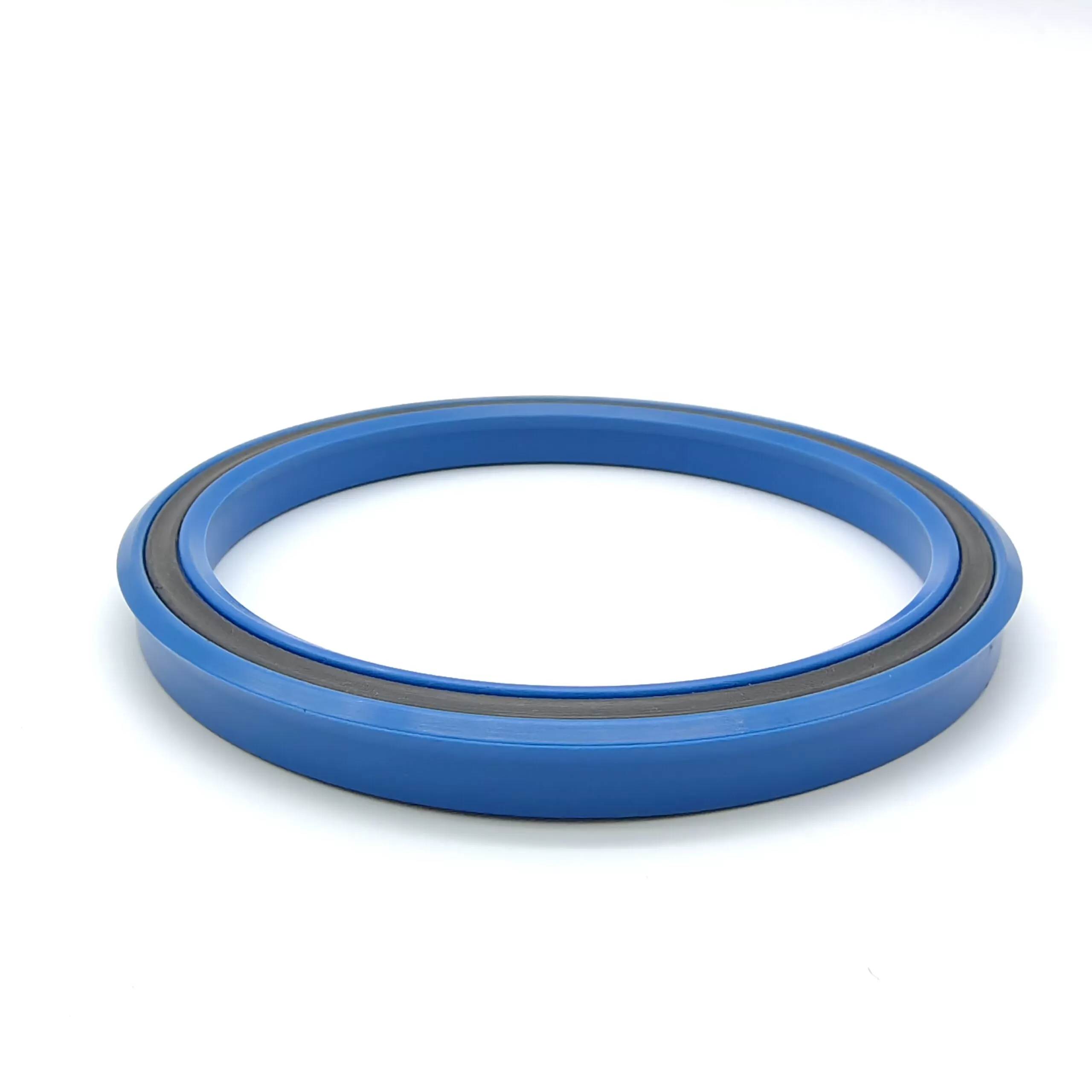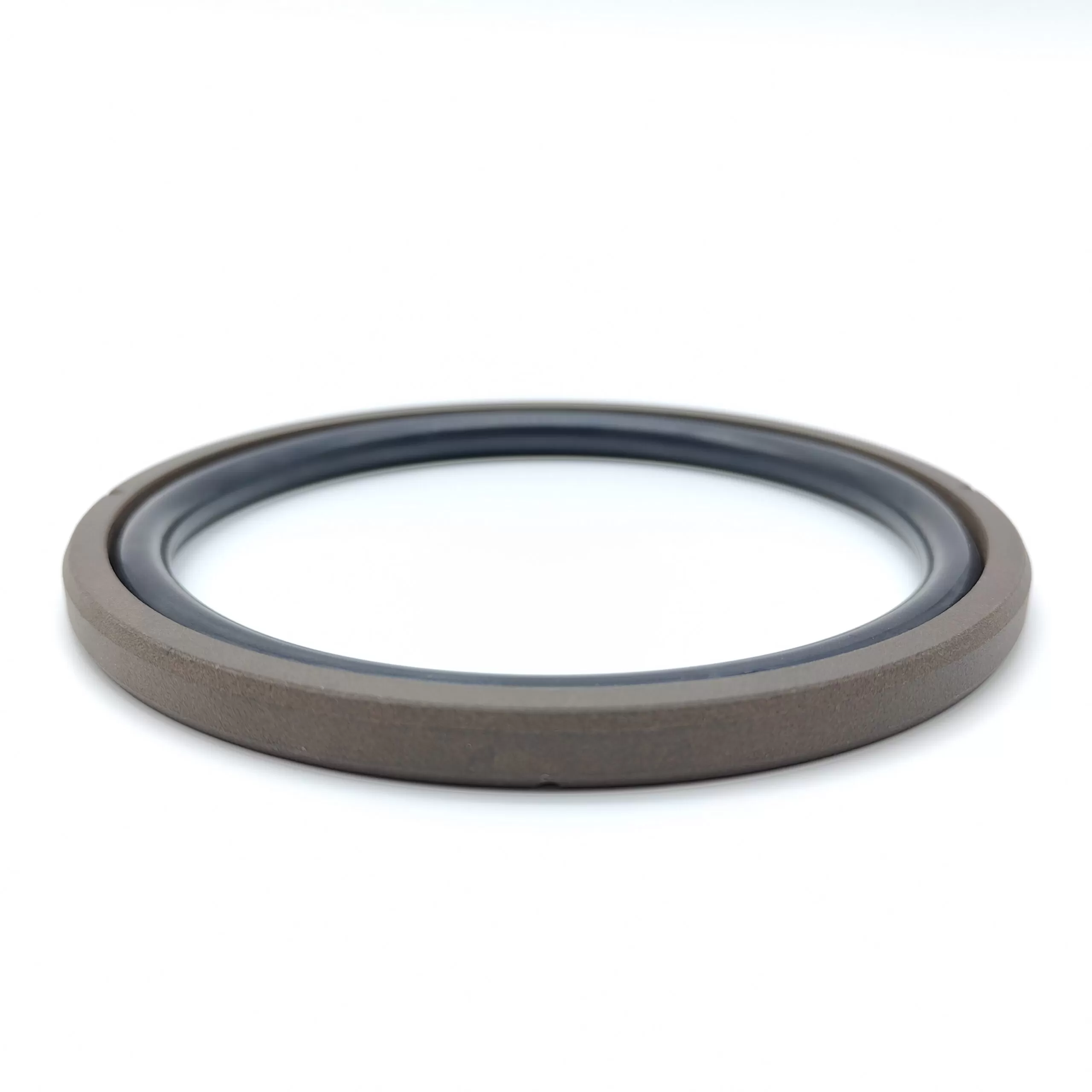
That question often arrives with a photo of a used seal, a faded part number, and three dimensions measured with a caliper.
The machine may already be waiting for repair. The original seal may be out of stock, the lead time may be too long, or the maintenance team may simply want to qualify a second source.
The obvious solution seems simple: find another seal with the same dimensions.
That is also where many replacement projects go wrong.
A reliable Trelleborg hydraulic seal replacement should not be selected by appearance, color, ID × OD × width, or generic material name alone. The replacement should reproduce the required sealing function while matching the groove geometry, pressure direction, energizer, material behavior, hydraulic fluid, temperature, speed, extrusion clearance, and mating surface.
Can a Trelleborg Hydraulic Seal Be Replaced With Another Brand?
Yes. In many industrial hydraulic applications, a Trelleborg seal can be replaced by a correctly engineered equivalent from another manufacturer.
But equivalent does not mean visually identical.
Trelleborg describes Turcon® Stepseal® 2K as a single-acting O-ring energized dynamic rod seal, while Turcon® Glyd Ring® is a double-acting O-ring energized piston seal. The correct replacement therefore depends on function and application, not just shape.
The better question is: “What seal performs the same function in this groove and under these operating conditions?”
Before Cross-Referencing: Collect These 12 Critical Inputs
- Original Trelleborg part number, if available
- Seal function
- Rod or cylinder bore diameter
- Groove diameter
- Groove width
- Groove depth
- Pressure direction
- Continuous and peak pressure
- Hydraulic fluid
- Temperature range
- Sliding speed
- Original material or seal profile, if known
Also send clear photos of the old seal and groove, the cylinder drawing or equipment model when available, and the required quantity or annual consumption.
• color
• visual appearance
• ID × OD × width only
• generic terms such as “PTFE” or “PU”
• similar-looking brand part numbers
A replacement should be approved from function + profile + groove + material + application conditions.
Common Trelleborg Seal Families and Comparable TYS Series Directions
A useful cross-reference should compare more than product names. The engineer should first compare:
seal function → profile geometry → groove → energizer → material → operating conditions.
| Seal Type | Typical Trelleborg Family | TYS Series Code / Direction | Key Matching Points | Direct Interchange? |
|---|---|---|---|---|
| Single-acting rod seal | Turcon® Stepseal® 2K | GSJ Step Seal | Step direction, groove, O-ring energizer, extrusion gap, PTFE compound | No – verify engineering details |
| Double-acting piston seal | Turcon® Glyd Ring® / Glyd Ring® T | SPGO Glyd Ring | Groove width, radial section, energizer, pressure, clearance | No – verify engineering details |
| PU U-Cup rod/piston seal | Zurcon® U-Cup / similar lip-seal family | MPS PU U-Cup | Lip geometry, preload, PU grade, temperature, extrusion clearance | No – profile and material check required |
| Buffer seal | Trelleborg buffer-seal families | HBY Buffer Seal | Peak pressure, back-pressure relief, gap, primary rod-seal arrangement | No |
Important: This is a functional/profile mapping table, not a direct part-number interchange chart. Final selection must be checked against the actual groove and duty conditions.
What Do These Profiles Look Like?
For buyers without the original part number, profile geometry provides an important identification clue.
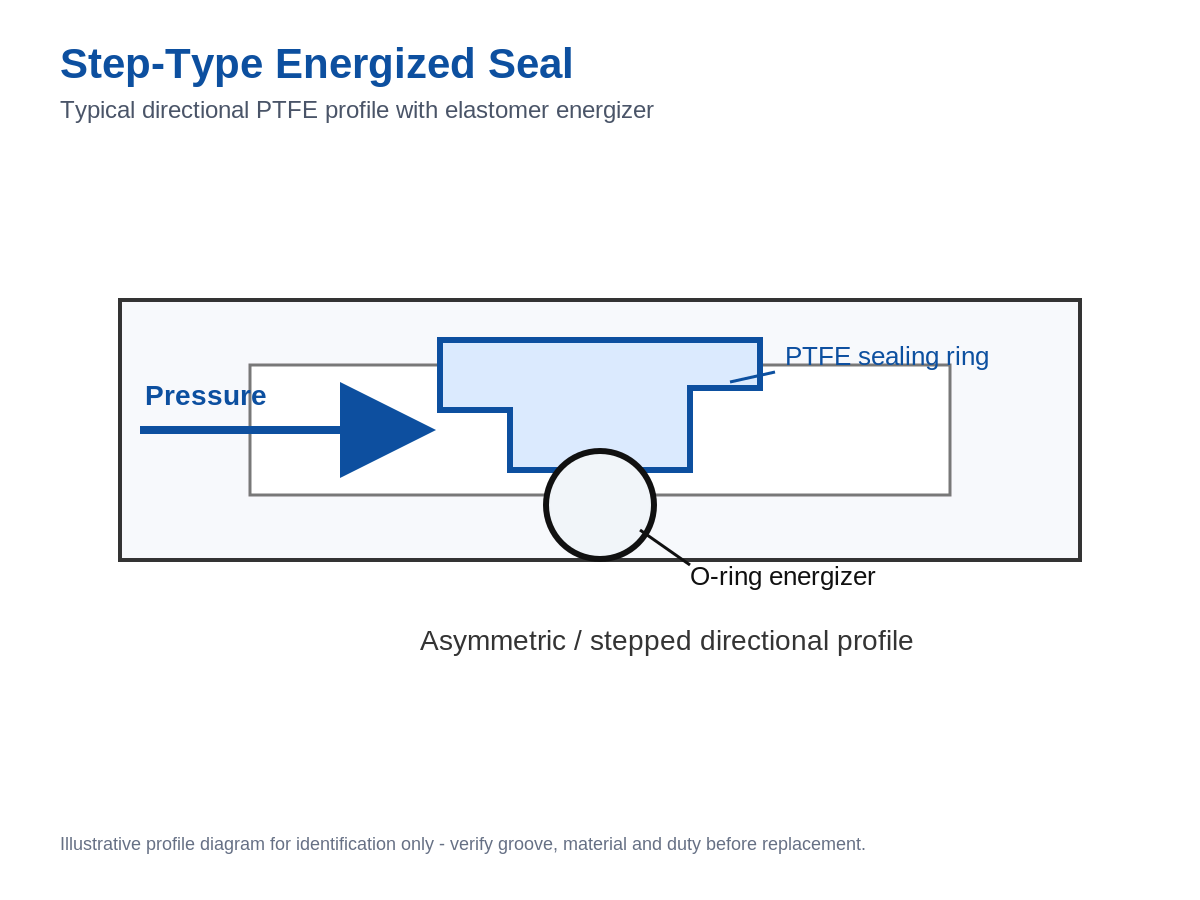
Step-Type Energized Profile
A step-type seal normally combines an asymmetric PTFE sealing element with an elastomer energizer. Pressure direction matters, so it should not be treated as a generic rectangular PTFE ring.
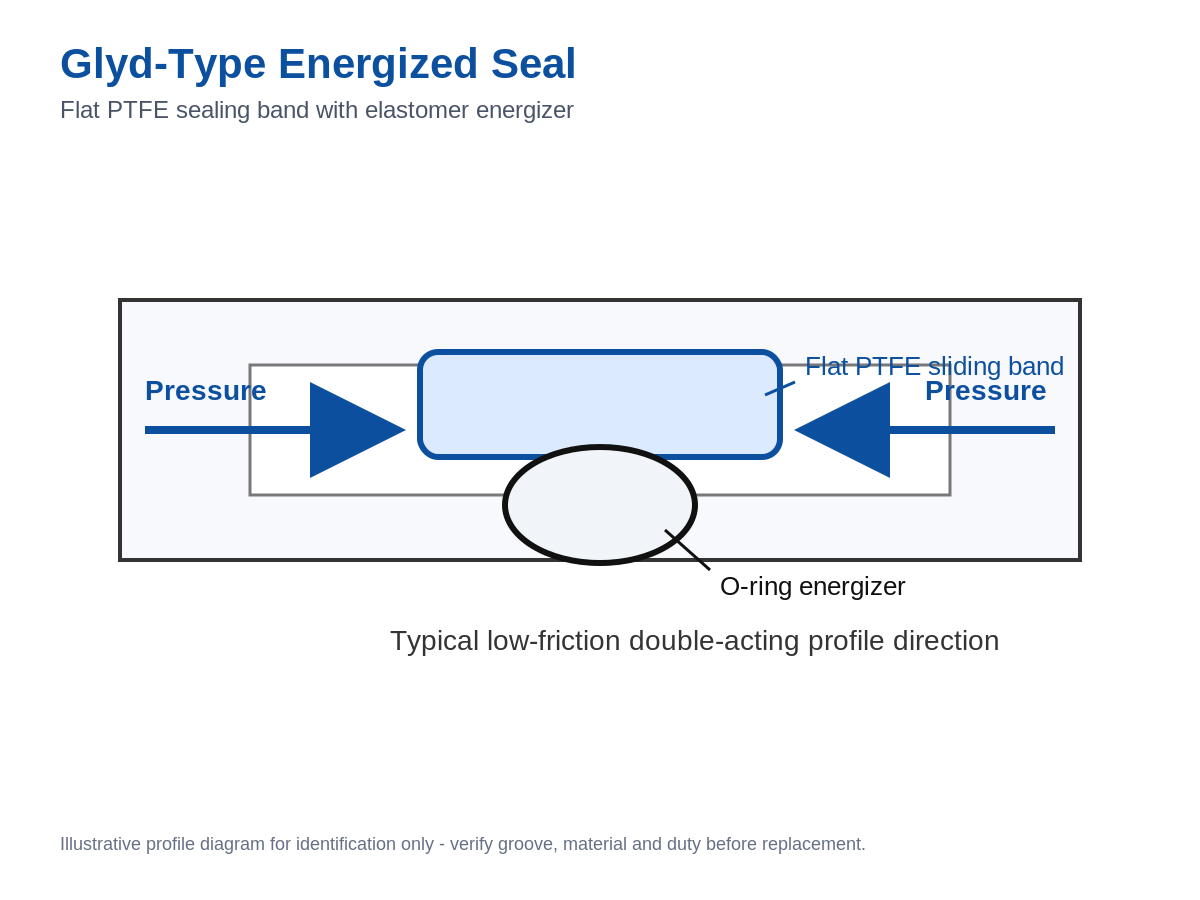
Glyd-Type Energized Profile
A Glyd-type profile normally uses a relatively flat PTFE sliding band energized from underneath by an O-ring. It is commonly selected where low friction and double-acting sealing are required.
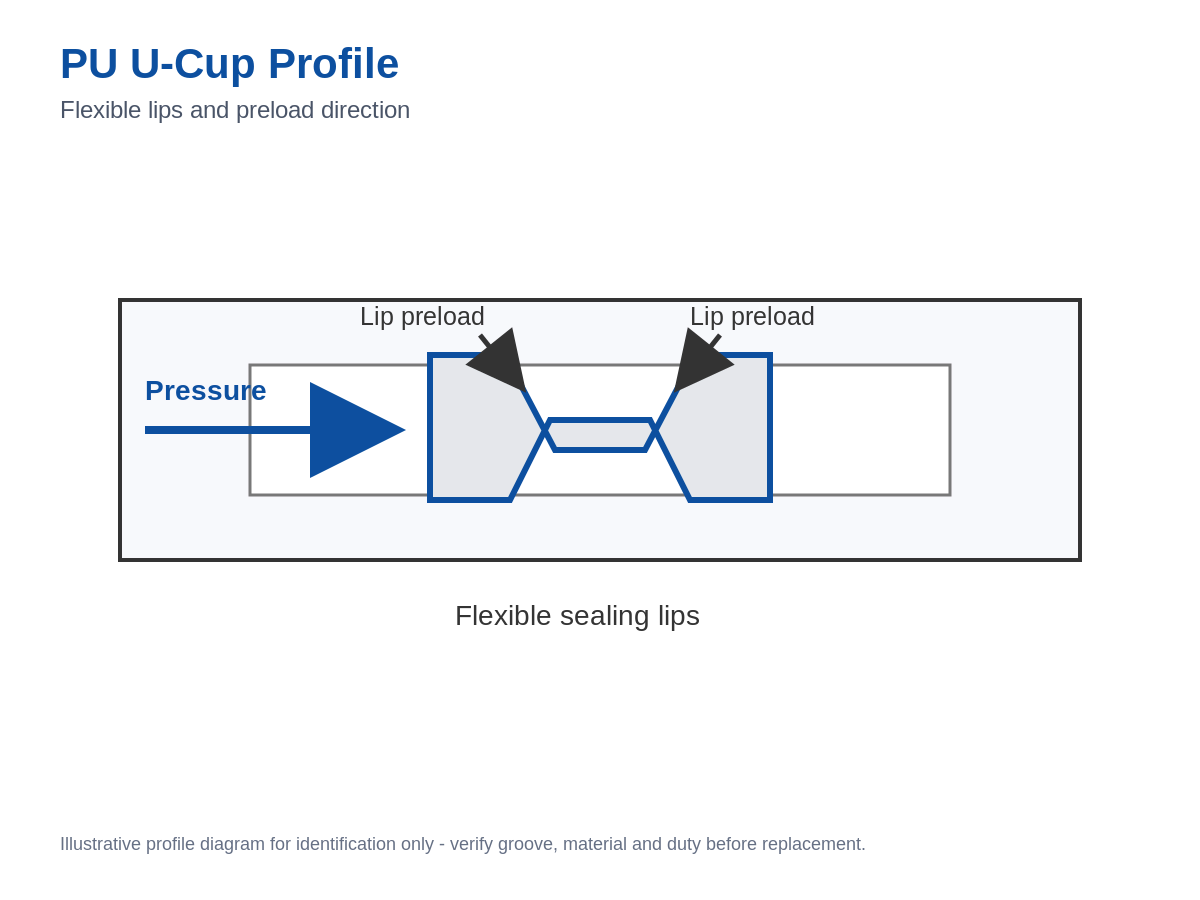
PU U-Cup
A U-cup uses flexible sealing lips rather than a flat energized PTFE running surface. Lip geometry, preload, PU compound, and extrusion clearance strongly affect performance.
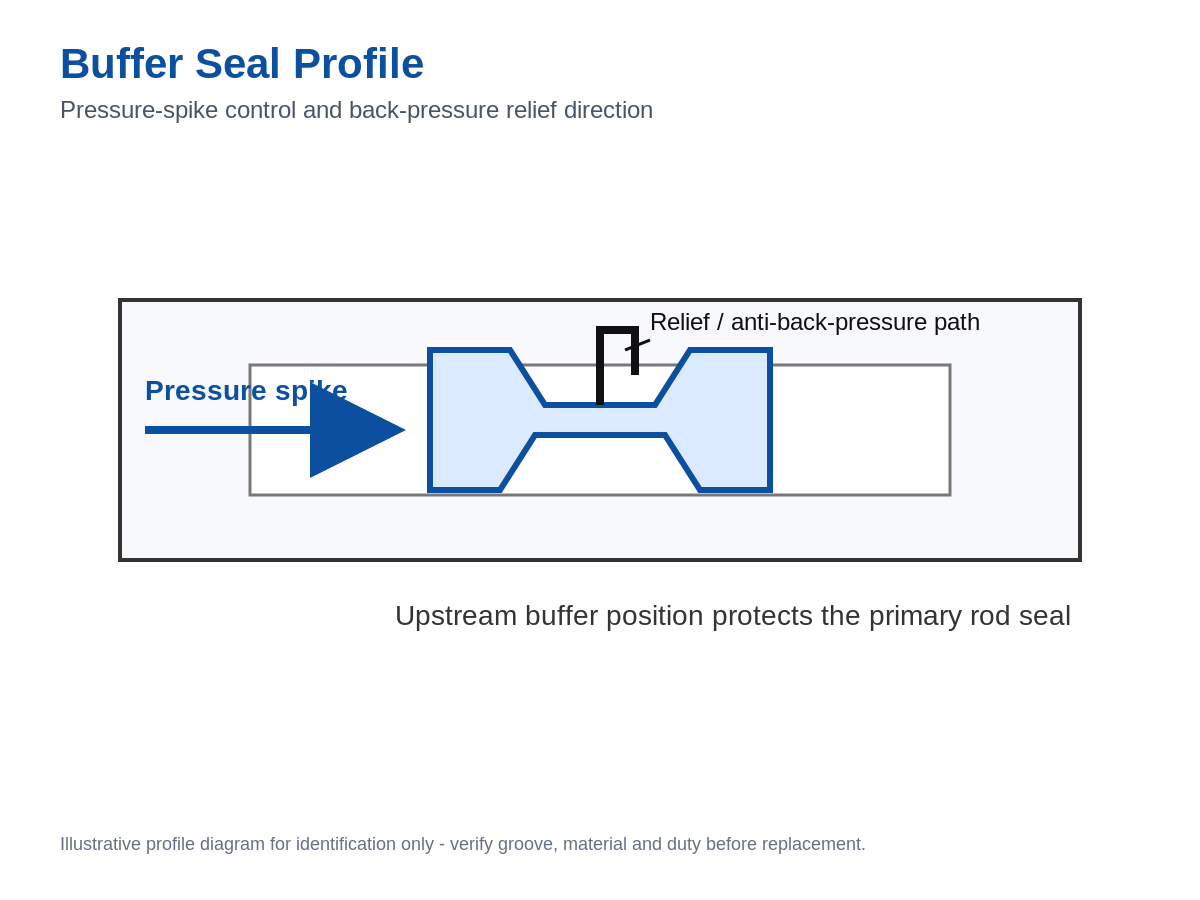
Buffer Seal
A buffer seal normally sits upstream of the primary rod seal to absorb surge pressure and protect the main sealing element. The TYS HBY buffer seal, for example, is used together with rod seals under heavy-load pressure fluctuations.
Step 1: Find the Original Part Number
Start with the original Trelleborg number whenever possible. Check packaging, maintenance records, equipment manuals, BOMs, invoices, seal markings, and cylinder drawings.
A known number can speed up identification, but the actual groove should still be checked if the cylinder has previously been rebuilt or modified.
Step 2: Confirm the Seal Function
Determine whether the component is a rod seal, piston seal, buffer seal, wiper, wear ring, O-ring, or backup ring. A badly worn seal can lose important geometry after long service, so appearance alone is not enough.
Step 3: Measure the Hardware – Not Only the Old Seal
When the original part number cannot be confirmed, the most useful dimensions usually come from the metal groove.
A used seal may have permanent compression set, swelling, wear, extrusion damage, shrinkage, or thermal deformation. Measuring only the removed seal can therefore introduce errors.
For a Rod-Seal Groove
Record at minimum:
- d = rod diameter
- D = groove or gland diameter
- L = groove width
Example: if d = 50 mm and D = 60.7 mm, then S = (60.7 – 50) / 2 = 5.35 mm.
The supplier can then evaluate the required radial seal section together with groove width, profile, pressure, extrusion gap, and energizer.
Send TYS your measured D, d and L, together with a clear seal photo, pressure, fluid, temperature, and quantity. The engineering team can evaluate whether an existing profile or a custom hydraulic seal is more suitable.
For a Piston-Seal Groove
For piston applications, record the cylinder bore diameter, piston diameter, groove-bottom diameter, groove width, and radial clearance.
This is only a dimensional reference. Final selection must also consider groove width, extrusion clearance, energizer, pressure direction, and the actual seal profile. Do not automatically apply the rod-seal equation to piston hardware.
Dimensions That Should Still Be Checked
- extrusion clearance
- groove corner radius
- lead-in chamfer
- gland concentricity
- surface finish
- pressure direction
- energizer dimensions
At high pressure, excessive extrusion clearance can allow polyurethane or elastomeric elements to deform into the gap. A relatively small clearance difference can therefore matter more than a small difference in nominal seal diameter.
Step 4: Record the Operating Conditions
Record normal pressure, peak pressure, fluid, minimum and maximum temperature, sliding speed, duty cycle, contamination, side load, and whether the cylinder works indoors or outdoors.
Step 5: Match the Material System
Do not assume PTFE = PTFE or PU = PU.
| Material Direction | Typical Strength | What Must Be Checked |
|---|---|---|
| Filled PTFE | Low friction, speed, chemical resistance | Filler, load, energizer, extrusion clearance |
| Polyurethane | Wear and extrusion resistance | Temperature, hydrolysis, hardness, pressure |
| NBR | Economical energizer/static sealing | Fluid and temperature |
| FKM | Heat and chemical resistance | Low-temperature behavior and media |
How to Compare Trelleborg Materials With TYS Material Options
Material cross-referencing should be based on required friction, wear, extrusion, temperature, and media performance – not only a generic polymer name.
TYS publicly lists filled PTFE formulations including PTFE GL-MOLY (Glass + Moly), PTFE CF (Carbon Fiber), PTFE CGT (Carbon + Graphite), and PTFE BR-MOLY (40% Bronze + Moly).
Bronze-filled PTFE, for example, is commonly considered when improved wear resistance, compressive strength, and dimensional stability are required. That does not make it an automatic substitute for every branded bronze-filled PTFE compound. The application still has to be reviewed.
Scientific Data: Why Pressure and Temperature Matter
Seal replacement is partly a tribology problem, not only a dimensional problem.
A 2023 study in Engineering Failure Analysis tested a polyurethane U-cup at 100, 250, and 400 bar at a shaft velocity of 0.15 m/s. The greatest wear, extrusion, and deformation were reported at 400 bar, and friction-generated interfacial temperature was identified as an important contributor to degradation. View the research.
Engineering takeaway: a seal that works at one pressure cannot be assumed suitable at a substantially higher pressure simply because the groove dimensions are identical.
Check the Hardware Before Blaming the Seal
A correctly selected replacement cannot repair damaged cylinder hardware. Inspect the rod for pitting, chrome damage, corrosion, scratches, dents, and contamination. Inspect the bore for scoring, corrosion, taper, ovality, and honing damage. Inspect the groove for burrs, damaged edges, incorrect radius, deformation, and contamination.
If a new seal still leaks, use TYS’s guide to hydraulic cylinder leaks after installing new seals to check mechanical, material, and system causes before changing brands again.
How to Replace an Unknown or Obsolete Trelleborg Seal
Use evidence in this order:
- Original drawing
- Original part number
- Equipment BOM
- Groove dimensions
- Rod or bore dimensions
- Application conditions
- Old seal dimensions
- Photos
Old seal measurements are deliberately near the bottom because a used seal may be compressed, worn, swollen, shrunk, extruded, or thermally degraded.
Standard Replacement or Custom Replacement?
the function is clearly identified, the groove matches an existing profile, material requirements are known, and operating conditions fall inside the profile’s application window.
the original profile is obsolete, the groove is non-standard, no reliable cross-reference exists, only an old sample is available, repeated failure suggests the original design should be reconsidered, or a special material is required.
TYS provides custom machined seals and custom hydraulic sealing solutions for non-standard and application-specific requirements.
6 Common Trelleborg Seal Replacement Mistakes
1. Matching Only ID × OD × Width
Necessary – but not sufficient.
2. Replacing PTFE With PU Without Reviewing Friction
The new seal may hold pressure but alter starting and running friction.
3. Ignoring the Energizer
O-ring material, hardness, dimensions, and compression are part of an energized sealing system.
4. Identifying Material by Color
Seal color is not a reliable material specification.
5. Replacing Only the Failed Rod Seal
Also inspect the wiper, buffer seal, guide ring, rod condition, alignment, and pressure spikes.
6. Buying a Generic Seal Kit Without Verification
A complete kit is useful only when its components match the real cylinder.
Practical TYS Case: When a Replacement Needed More Than a Catalog Match
In a TYS-published replacement case involving imported Parker/SKF sealing solutions, a chemical manufacturer was experiencing recurring leakage and high maintenance cost in high-temperature, high-pressure service. TYS reports that its engineers reviewed the application, adjusted the sealing structure, and added an FKM O-ring to improve the solution rather than simply copying the existing seal.
According to the supplier-published case, equipment downtime was reduced by approximately 30% after implementation. Because this is a TYS customer case rather than an independent test, the result should be treated as application-specific evidence, not a universal performance guarantee. Read the TYS replacement case study.
Expert Insight: Cross-Reference Is Moving Toward Application Qualification
Traditional replacement purchasing often follows original part number → alternative part number.
For critical hydraulic equipment, a more robust process is:
This is particularly useful when the original seal is obsolete, lead time is long, repeated failure exists, annual consumption is high, or the buyer wants a qualified second source.
What Are the Benefits of Using a Qualified TYS Alternative?
1. Second-Source Qualification
A qualified alternative reduces dependence on a single sealing source.
2. Obsolete and Hard-to-Find Replacements
Older equipment can often be supported by evaluating the original groove, sample, drawing, and operating conditions.
3. Custom Sizes and Non-Standard Grooves
CNC machining supports non-standard hydraulic seal dimensions for OEM and legacy equipment.
4. Material Optimization
If the original seal repeatedly fails, alternative PTFE or polyurethane compounds can be evaluated against the failure mechanism.
5. Better Cost Control for Repeat Orders
The target should be lower total maintenance cost – not simply the lowest seal price.
Buyer Quick Decision
- Have the original part number? Start with a cross-reference, then verify the groove and duty.
- No part number? Measure the metal groove.
- Original seal keeps failing? Investigate the failure mechanism before copying the material.
- Non-standard groove? Evaluate a custom seal.
- Large annual consumption? Qualify the replacement through samples and retain an approved specification.
RFQ Checklist for a Trelleborg Hydraulic Seal Replacement
For the fastest technical evaluation, send at least:
part number + quantity + seal photo + rod/bore size + groove dimensions + pressure + fluid + temperature
Use the printable Hydraulic Seal Groove Measurement & Cross-Reference Worksheet to record D, d, L, pressure, fluid, temperature, photos, and failure information before sending your enquiry.
FAQ
Can Trelleborg hydraulic seals be replaced with aftermarket seals?
Yes. Many Trelleborg hydraulic seals can be replaced with engineered aftermarket equivalents, provided the replacement matches the original seal function, groove geometry, pressure direction, material requirements, fluid, temperature, speed, and extrusion conditions.
How do I find the equivalent of a Trelleborg seal part number?
Start with the original Trelleborg part number and identify its seal family and function. Then compare the rod or bore size, groove dimensions, material, pressure, fluid, temperature, and speed with the proposed replacement.
Can I replace a Trelleborg Turcon seal with another PTFE seal?
Possibly, but not simply because both use PTFE. The replacement must also match the profile, filler system, energizer, pressure direction, groove geometry, extrusion gap, and operating conditions.
What information is needed to replace a Trelleborg Glyd Ring?
Provide the original part number if available, rod or bore diameter, groove diameter and width, seal location, working pressure, fluid, temperature, speed, and photos or drawings.
Why does a hydraulic cylinder still leak after replacing the seal?
Leakage can result from incorrect selection or installation, but it can also come from a damaged rod, worn bore, excessive guide clearance, pressure spikes, contamination, incorrect orientation, or incompatible material.
Conclusion: Replace the Function, Not Just the Part Number
A Trelleborg hydraulic seal replacement should not be treated as a simple dimensional copy.
A more reliable cross-reference process is:
Part number → Seal function → Groove geometry → Material → Operating conditions → Candidate profile → Sample validation
A known part number can make the process faster. But when it is unavailable, the groove and application conditions become the real engineering specification.
When the original seal repeatedly fails, the goal should not necessarily be to reproduce the old material exactly. The better solution may be to preserve the required sealing function while changing the material or profile to address the real failure mechanism.
For OEMs, distributors, repair companies, and fleet operators, the goal of a qualified aftermarket program is not merely a lower seal price. It is to create a repeatable second source with controlled dimensions, controlled materials, and clearly defined application limits.
Send the original part number if available. If not, send the seal photo, groove dimensions, rod or bore diameter, pressure, fluid, temperature, and required quantity. TYS can evaluate whether a standard hydraulic seal profile or a custom replacement is the more appropriate direction.
Trademark Notice: Trelleborg®, Turcon®, Zurcon®, Stepseal®, and Glyd Ring® are trademarks associated with their respective owner. TYS is an independent hydraulic seal manufacturer and is not affiliated with, authorized by, sponsored by, or endorsed by Trelleborg. Product and brand names are used only for identification, replacement research, and technical comparison.